Introduction: Why Cleanroom Classification Matters (ISO 14644)
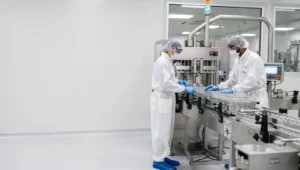
In the life sciences industry, cleanrooms are not just facilities—they are the frontline defense protecting patients from harm. Every injectable drug, implantable device, and ophthalmic product must be manufactured in an environment that controls contamination to levels that ensure patient safety.
But how do we define what “clean” means? How do we measure it? And how do we ensure consistency across different facilities, companies, and even countries?
The answer lies in ISO 14644—the international standard that provides the global language for cleanroom classification and operation. For professionals in pharmaceutical, biotechnology, and medical device manufacturing, understanding this standard isn’t optional. It’s essential for product sterility, patient safety, and regulatory compliance.
A Brief History: From Military Origins to Global Consensus
The journey of cleanroom standards began not in healthcare, but in the military. In March 1961, the United States Air Force published Technical Manual 00-25-203, driven by the need for reliable manufacturing of guidance systems and electronics for the space race. This pioneering document established the foundational concepts—cleanroom design principles, airborne particle standards, entry procedures, and specialized clothing requirements—that remain relevant today.
These concepts were formalized into Federal Standard 209 in 1963, which introduced the familiar Class 100, Class 10,000, and Class 100,000 designations based on particles per cubic foot. For decades, this was the global benchmark.
But by the 1990s, multiple national standards had created confusion for global manufacturers. A company producing for international markets might need to comply with Federal Standard 209 in the US, British Standard 5295 in the UK, and other national standards elsewhere—all with different units and classification systems.
In 1993, the International Organization for Standardization formed Technical Committee 209 with a clear mandate: develop a single, comprehensive, globally accepted family of cleanroom standards. The result was ISO 14644-1, published in 1999.
Today, ISO 14644 is recognized and adopted by regulatory authorities worldwide, integrated into EU GMP Annex 1, WHO guidelines, and PIC/S documents. It has truly become the universal language of contamination control.
The ISO 14644 Series: A Family of Standards
ISO 14644 is not a single document—it’s a comprehensive family of standards, each addressing a different aspect of cleanroom technology. The most critical parts for life sciences professionals include:
| Part | Title | Key Focus |
|---|---|---|
| Part 1 | Classification of Air Cleanliness by Particle Concentration | Foundational classification requirements |
| Part 2 | Monitoring to Provide Evidence of Cleanroom Performance | Ongoing monitoring and trend analysis |
| Part 3 | Test Methods | Detailed procedures for all cleanroom parameters |
| Part 4 | Design, Construction, and Start-Up | Lifecycle approach to cleanroom projects |
| Part 5 | Operations | Operational requirements and personnel behavior |
| Part 7 | Separative Devices | Isolators, gloveboxes, and mini-environments |
| Part 8 | Classification by Chemical Concentration | Airborne chemical contamination control |
| ISO 14698 | Biocontamination Control | Viable microbiological contamination |
This modular approach allows professionals to focus on the specific aspects most relevant to their work while maintaining consistency across the entire contamination control framework.
The ISO Classification System: How It Works
The ISO classification system is based on a mathematical formula that provides scientific rigor and allows for consistent application across different particle sizes and cleanliness levels.
Key Principles:
- Logarithmic Progression: Each increase of one in the class number represents approximately a tenfold increase in allowable particle concentration. This creates a logical and scalable system.
- Particle Size Relationship: In typical environments, smaller particles are more numerous than larger ones. As the particle size being measured increases, the allowable concentration decreases.
- Metric Units: All particle concentrations are expressed as particles per cubic meter of air, aligning with international practice.
Standard ISO Classes for Life Sciences:
For pharmaceutical applications, the most relevant classes are ISO Class 5, ISO Class 7, and ISO Class 8:
| ISO Class | Regulatory Grade | Particle Size | Limit (particles/m³) | Application |
|---|---|---|---|---|
| ISO 5 | Grade A | ≥0.5 μm | 3,520 | Aseptic filling, critical zones |
| ISO 5 | Grade A | ≥5.0 μm | 29 | Aseptic filling, critical zones |
| ISO 7 | Grade B (operational) | ≥0.5 μm | 352,000 | Background for aseptic areas |
| ISO 7 | Grade C (at-rest) | ≥5.0 μm | 2,930 | Background for aseptic areas |
| ISO 8 | Grade D (at-rest) | ≥0.5 μm | 3,520,000 | Support areas |
ISO Class 5 corresponds approximately to the former Federal Standard Class 100, while ISO Class 7 corresponds to Class 10,000, and ISO Class 8 to Class 100,000.
The Three Occupancy States
Understanding occupancy states is critical because regulatory expectations differ for each state:
| State | Condition | Application |
|---|---|---|
| As-built | Installation complete, no equipment or personnel | Initial qualification, baseline performance |
| At-rest | Equipment installed and operating, no personnel | Equipment validation, less critical areas |
| Operational | Equipment operating with personnel present | Aseptic processing, critical areas |
For aseptic filling areas (Grade A, ISO Class 5), classification in the operational state is mandatory. Human activity is the primary source of contamination, and the classification must reflect actual production conditions.
Determining Sampling Locations and Volumes
Number of Sampling Locations:
The minimum number of sampling locations is determined by taking the square root of the area in square meters and rounding up to the next whole number.
For example:
- A 25 m² cleanroom requires 5 locations (√25 = 5)
- A 40 m² cleanroom requires 7 locations (√40 ≈ 6.32, rounded up to 7)
- A 100 m² cleanroom requires 10 locations (√100 = 10)
Sample Volume Requirements:
The minimum sample volume ensures that at least 20 particles are detected if the concentration is at the class limit. For ISO Class 5 at ≥0.5 μm, this is approximately 5.7 liters. In practice, most particle counters operate at 28.3 liters per minute, so a one-minute sample exceeds this requirement.
For ISO Class 5 at ≥5.0 μm, the required volume is approximately 690 liters—about 24 minutes at 28.3 L/min. This is why many pharmaceutical applications focus classification on 0.5 μm particles and use continuous monitoring or longer sample times for larger particles.
Statistical Analysis: The 95% Upper Confidence Limit
When the number of sampling locations is between 2 and 9 inclusive, the 95% upper confidence limit must be calculated and must be less than or equal to the class limit.
| Number of Locations | 95% UCL Required? |
|---|---|
| 1 | No |
| 2–9 | Yes |
| 10 or more | No |
This calculation addresses the uncertainty inherent in sampling only a limited number of locations. It provides statistical confidence that the entire cleanroom area, not just the sampled points, meets the classification requirement.
Integration with Regulatory Frameworks
EU GMP Annex 1
Annex 1 explicitly links its four cleanliness grades to ISO 14644-1 classifications:
| Annex 1 Grade | ISO 14644-1 Classification | Key Characteristics |
|---|---|---|
| Grade A | ISO Class 5 (operational) | Critical zone for high-risk operations |
| Grade B | ISO Class 5 (at-rest), ISO Class 7 (operational) | Background environment for Grade A |
| Grade C | ISO Class 7 (at-rest), ISO Class 8 (operational) | Less critical areas |
| Grade D | ISO Class 8 (at-rest) | Support areas |
FDA Guidance
While the FDA’s 2004 guidance on aseptic processing uses different terminology—“Critical Areas” and “Controlled Areas”—and references Federal Standard classes, the agency recognizes ISO 14644 and expects facilities to comply with current industry standards. Critical areas must meet Class 100 conditions (approximately ISO Class 5), and Controlled Areas must meet Class 100,000 conditions (approximately ISO Class 8).
WHO and PIC/S
Both WHO GMP and PIC/S GMP align with ISO 14644, using the same grade designations as EU GMP and explicitly referencing ISO classification.
Cleanroom Qualification vs. Monitoring
It’s important to distinguish between classification, qualification, and monitoring:
| Activity | Purpose | Frequency |
|---|---|---|
| Classification | Initial determination of cleanliness | Initial and at defined intervals |
| Qualification | Comprehensive assessment of compliance | Initial and periodic (6–12 months) |
| Monitoring | Ongoing demonstration of continued compliance | Daily to monthly |
Requalification Requirements (EU GMP Annex 1):
- Grade A & B areas: 6 months
- Grade C & D areas: 12 months
Common Pitfalls and How to Avoid Them
1. Improper Sampling Locations
Problem: Placing sampling locations directly under HEPA filters or away from representative areas.
Solution: Locations must be evenly distributed throughout the area at working height (0.75–1.5 meters), away from air supply diffusers and return air grilles.
2. Insufficient Sample Volume
Problem: Not sampling enough air to detect 20 particles at the class limit.
Solution: Calculate minimum sample volume for each particle size and ensure sample duration is sufficient.
3. Ignoring Occupancy States
Problem: Testing in the wrong occupancy state for the application.
Solution: Grade A areas require operational state classification. Grade C and D areas may be classified at-rest.
4. Misinterpreting Statistical Requirements
Problem: Failing to calculate the 95% UCL when required (2–9 locations).
Solution: Know when the UCL applies and how to calculate it correctly.
Why This Matters for Your Career
Understanding ISO 14644 cleanroom classification directly impacts your effectiveness in various life sciences roles:
- Quality Assurance Professionals: The standards provide objective criteria for reviewing validation reports, investigating deviations, and preparing for inspections.
- Validation Engineers: The entire qualification effort is built around ISO 14644 requirements—from IQ through OQ to PQ.
- Manufacturing Personnel: Understanding why standards exist transforms compliance from arbitrary rules into meaningful commitment to patient safety.
- Regulatory Affairs Professionals: Demonstrating alignment with ISO 14644 supports compelling regulatory submissions.
- Senior Management: Understanding the standards enables informed decisions about facility design, resource allocation, and risk management.
Master Cleanroom Classification with GxP Trainings
At GxP Trainings, we offer comprehensive training programs designed to help life sciences professionals master cleanroom classification, contamination control, and regulatory compliance.
Our Certified Cleanroom Operations and Validation Professional (CCOVP) program provides deep, complete understanding of cleanroom technology—from fundamental principles to advanced operational and regulatory requirements. The program covers:
- ISO 14644 series (Parts 1–17)
- EU GMP Annex 1 requirements
- FDA 21 CFR Parts 210 and 211
- Cleanroom design, HVAC, and engineering
- Commissioning, qualification, and validation
- Environmental monitoring programs
- Auditing principles (ISO 19011)
Whether you’re a Quality Assurance professional, Validation Engineer, Manufacturing Supervisor, or Regulatory Affairs specialist, our GxP training courses provide the knowledge and credentials you need to excel.
Explore our Cleanroom Training Programs →
Related Articles
Looking to deepen your knowledge? Check out these related articles from our blog:
- Cleanroom Professional Certification | GxP Cleanroom Training – A comprehensive look at our flagship cleanroom certification program covering the complete lifecycle of cleanroom technology.
- Cleanroom Design & Operations I ISO 14644 I I ATMPs I CAR-T I – An in-depth exploration of ISO 14644 standards, from core concepts and classification to testing, monitoring, and integration with global regulations.
Conclusion
ISO 14644 cleanroom classification provides the global framework for ensuring that sterile products are manufactured in environments that protect patient safety. From the historical evolution of standards to the technical details of particle counting and statistical analysis, mastering these concepts is essential for life sciences professionals.
Whether you’re designing a new facility, validating a cleanroom, or preparing for a regulatory inspection, a thorough understanding of ISO 14644-1 classification requirements is your foundation for success.
Ready to take your cleanroom expertise to the next level? Visit GxP Trainings today to explore our comprehensive GxP training programs for the life sciences industry.
Author