
Introduction
The landscape of GxP compliance is shifting faster than ever. In 2026, regulatory expectations are no longer about ticking boxes or preparing for the occasional audit. Compliance has become a continuous operational discipline that must be visible, traceable, and consistently applied across every aspect of your organization.
From the FDA’s landmark Quality Management System Regulation (QMSR) that took effect on February 2, 2026, to the joint FDA-EMA guidance on Good AI Practice in Drug Development, the rules of the game have changed. Regulatory bodies are moving from exhaustive documentation audits toward data-driven, risk-based insights into processes.
Whether you are a pharmaceutical manufacturer, a biotech startup, a medical device company, or a contract research organization, achieving and maintaining GxP compliance in 2026 requires a fresh approach. This guide will walk you through everything you need to know—step by step.
What’s New in GxP Compliance for 2026?
Before diving into the how-to, it is essential to understand what has changed. Several major regulatory developments have reshaped the GxP landscape in 2026.
The FDA QMSR: A New Era for Medical Devices
On February 2, 2026, the FDA’s Quality Management System Regulation (QMSR) became effective, fundamentally changing the GMP requirements for medical devices. The revised 21 CFR Part 820 now incorporates by reference the international standard ISO 13485:2016, harmonizing the FDA’s framework with that used by regulatory authorities around the world.
What this means for you: If you manufacture medical devices or combination products, your quality management system must now align with ISO 13485. The FDA no longer uses the Quality System Inspection Technique (QSIT) and has replaced it with a new inspection process under Compliance Program 7382.850.
AI Governance: The New Regulatory Frontier
In January 2026, the FDA and EMA jointly published the “Guiding Principles of Good AI Practice in Drug Development,” establishing a governance framework for AI applications throughout the drug lifecycle. The guidance outlines ten principles, including risk-based validation, data governance, and lifecycle management for AI systems.
What this means for you: If you are using AI or machine learning in any GxP process—from drug discovery to manufacturing to pharmacovigilance—you need to demonstrate explainability, traceability, and human accountability for automated decisions.
EMA GMP Updates
The EMA has published an updated 3-year work plan for its Inspectors Working Group covering January 2026 to December 2028. Key updates include a revised Chapter 1 on the Pharmaceutical Quality System expected by the end of 2026, an updated guideline on active substance chemistry effective September 1, 2026, and a proposed revision of GMP Annex 15 on Qualification and Validation.
Data Integrity Takes Center Stage
In 2026, the complete data lifecycle has moved to the forefront of regulatory expectations. Authorities expect companies to identify critical data, understand its creation and processing, and implement appropriate protective measures. Data integrity is no longer a supporting discipline—it is a foundational pillar of any GxP process.
Summary of Key 2026 Regulatory Changes
| Regulation / Guideline | Effective Date | Key Impact |
|---|---|---|
| FDA QMSR (21 CFR Part 820) | February 2, 2026 | Medical device QMS must align with ISO 13485; new inspection process |
| FDA-EMA Good AI Practice Guidance | January 2026 | Governance framework for AI in drug development; risk-based validation required |
| EMA Chapter 1 Revision (Pharmaceutical Quality System) | Expected late 2026 | Updated PQS expectations |
| EMA Active Substance Guideline | September 1, 2026 | Updated chemistry requirements |
| EMA GMP Annex 15 Revision | Proposed | Updated qualification and validation expectations |
| Data Integrity Focus | Ongoing | Complete data lifecycle scrutiny; ALCOA+ across all systems |
Step-by-Step Guide to Becoming GxP Compliant in 2026
Now that you understand the landscape, here is a practical step-by-step roadmap to achieving GxP compliance in 2026.
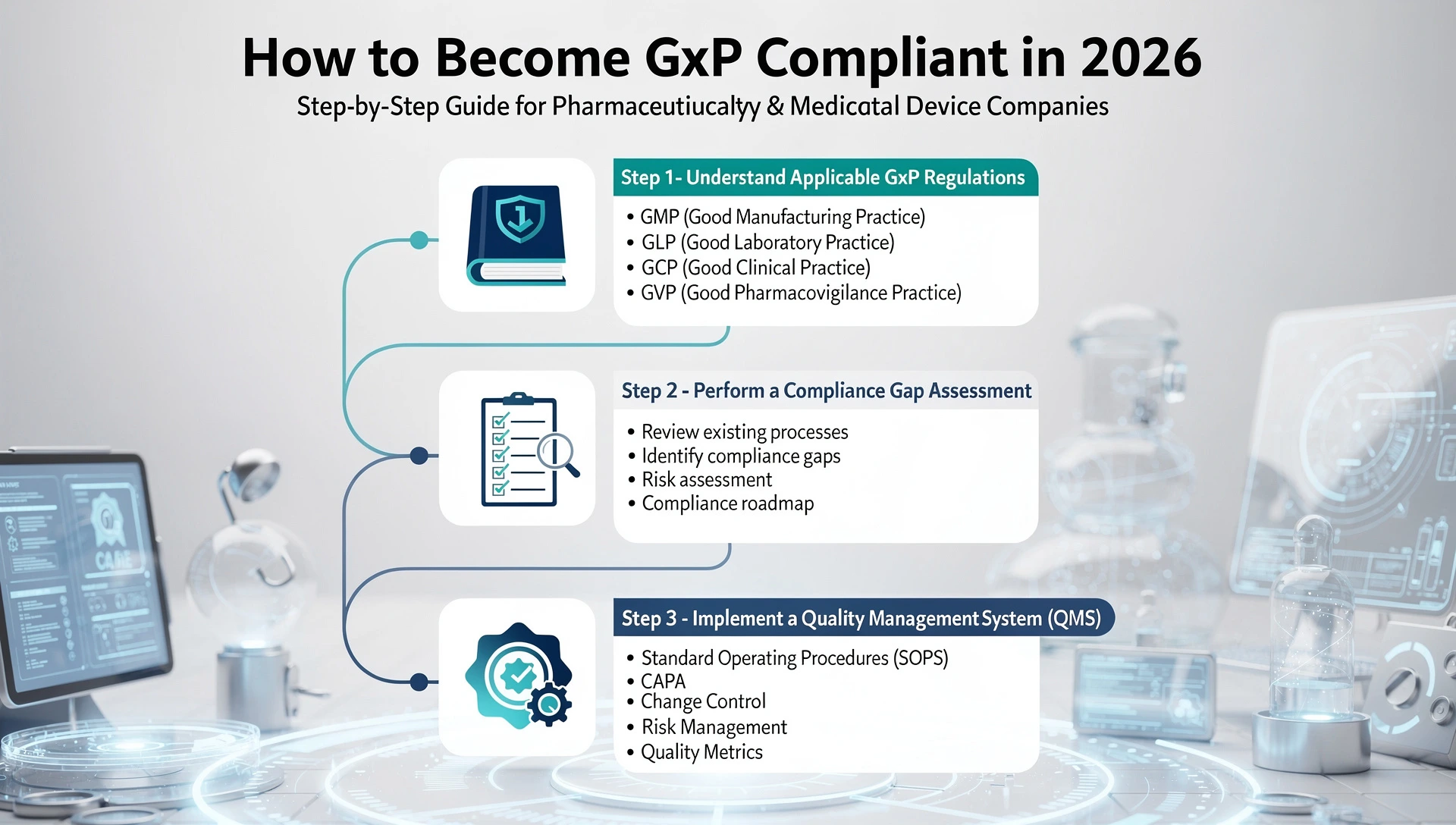
Step 1: Conduct a Comprehensive Gap Assessment
The first step is understanding where you stand today. A gap assessment compares your current processes, systems, and documentation against the latest regulatory requirements.
What to assess:
- Quality Management System: Does your QMS meet the requirements of ISO 13485 (for medical devices) or the updated Pharmaceutical Quality System expectations?
- Documentation practices: Are your records complete, accurate, and audit-ready?
- Training programs: Are all personnel trained on GxP principles and job-specific procedures?
- Computerized systems: Are your systems validated and compliant with 21 CFR Part 11?
- Supplier oversight: Do you have continuous vendor monitoring in place?
- Data integrity: Does your data meet ALCOA+ principles across its entire lifecycle?
- AI systems: If you use AI, do you have governance frameworks and validation in place?
Pro tip: Use risk-based gap assessments to prioritize your remediation efforts. Not all gaps carry the same level of risk.
Step 2: Update Your Quality Management System
Your Quality Management System is the backbone of GxP compliance. In 2026, it must be integrated, risk-based, and continuously monitored.
Key actions:
- For medical device manufacturers: Align your QMS with ISO 13485:2016 to meet the new QMSR requirements
- Implement a unified digital ecosystem that integrates QMS, Manufacturing Execution Systems (MES), and asset management platforms to eliminate data silos
- Embed quality risk management (ICH Q9) into all processes
- Ensure your QMS supports continuous improvement rather than periodic compliance checks
- For pharmaceutical companies: Prepare for the updated Chapter 1 expectations on the Pharmaceutical Quality System
Why this matters: Regulatory inspections in 2026 increasingly focus on how well quality systems are integrated into daily operations, not just on paper documentation.
Step 3: Strengthen Data Integrity and ALCOA+ Compliance
Data integrity is non-negotiable in 2026. The complete data lifecycle—from creation to archival—must be controlled and documented.
What regulators expect:
- All GxP data must meet the ALCOA+ principles: Attributable, Legible, Contemporaneous, Original, Accurate, plus Complete, Consistent, Enduring, and Available
- Critical data must be identified, and its creation and processing must be understood
- Data governance, culture, and system controls must be in place
- For AI-driven systems, regulators now expect “decision integrity”—visible AI contributions, clear human ownership, and records showing what was accepted, changed, or rejected
Practical steps:
- Conduct a data integrity risk assessment across all systems
- Implement audit trail reviews for all critical systems
- Ensure electronic records comply with 21 CFR Part 11
- Train all personnel on ALCOA+ principles and their practical application
- Review and update your data governance policies
Step 4: Implement AI Governance and Validation Frameworks
With the FDA-EMA guidance on Good AI Practice in Drug Development, AI governance is no longer optional.
Key requirements:
- Adopt a risk-based approach to AI validation, risk mitigation, and oversight
- Clearly define the context of use for each AI system
- Implement robust data governance and documentation
- Ensure AI decisions are explainable and traceable
- Maintain human accountability for all automated decisions
- Monitor for model drift and bias continuously
- Document training data sources and quality
Practical approach:
- Use the FDA’s Computer Software Assurance (CSA) guidance, which shifts focus from exhaustive documentation to risk-based critical thinking
- Follow the ISPE GAMP Guide for Artificial Intelligence for practical direction on applying established GxP concepts to AI-enabled systems
- Preserve core GxP validation principles while addressing AI-specific risks like probabilistic outputs, model drift, bias, and explainability limitations
Step 5: Establish Continuous Vendor Compliance
In 2026, risk-based vendor management has become a regulatory expectation. A significant proportion of regulatory observations are now linked to third-party and supplier-related gaps. Vendor qualification alone is no longer sufficient.
What to do:
- Move from point-in-time vendor qualification to continuous vendor compliance
- Implement ongoing performance monitoring and risk-based audits
- Integrate vendor management into your broader QMS
- For high-risk vendors, require more frequent audits, detailed quality agreements, and enhanced monitoring of deviations and CAPA effectiveness
- Maintain documented evidence of vendor oversight and performance tracking
Why this matters: Regulatory inspections in 2026 are increasingly focused on how well companies manage their third-party relationships. Inspectors expect clear evidence of ongoing vendor monitoring and performance tracking.
Step 6: Build Continuous Inspection Readiness
In 2026, inspection readiness is no longer a periodic activity conducted before an audit. It is a continuous operational discipline.
What this means:
- Your organization must be able to demonstrate compliance at any time, not just when an inspection is announced
- Compliance must be embedded in daily operations across manufacturing, warehousing, laboratories, pharmacovigilance, and computerized systems
How to build it:
- Conduct routine internal audits and mock inspections
- Perform risk-based gap assessments regularly
- Verify CAPA effectiveness
- Review data integrity and documentation continuously
- Conduct supplier and vendor audits
- Maintain continuous quality monitoring dashboards
- Ensure all documentation is current and audit-ready at all times
Regulators will evaluate:
- Quality Management Systems and SOP effectiveness
- Training records and employee competency
- Deviations, investigations, and CAPA management
- Change control and risk assessments
- Supplier qualification and vendor oversight
- Computerized systems and data integrity
- AI governance and validation (where applicable)
Step 7: Invest in Continuous Training and Competency Development
GxP compliance is only as strong as the people who implement it. In 2026, regulatory agencies expect documented evidence of ongoing training and demonstrated competency.
What to prioritize:
- Initial and ongoing training on GxP principles
- Job-specific procedure training
- Training on new regulations (QMSR, AI guidance, updated EMA guidelines)
- Data integrity and ALCOA+ training
- Audit readiness and inspection preparation training
- Documentation of training effectiveness and competency assessments
- Training on emerging technologies and digital systems
Step 8: Embrace Digital Transformation and Computer System Validation
Legacy, paper-based systems are increasingly inadequate as regulatory agencies demand real-time data, quick responses, and thorough audit trails.
What to implement:
- A unified digital ecosystem that integrates QMS, MES, and asset management
- Automated workflows that link deviations to CAPAs
- Real-time data visibility and reporting
- Digital audit trails that are complete and unalterable
- Computerized system validation (CSV) for all GxP systems
- Cloud validation and SaaS compliance where applicable
The payoff: Digital transformation reduces manual reconciliation, speeds up investigations, and establishes a robust data foundation for advanced applications like AI.
Step 9: Prepare for the New FDA Inspection Process
For medical device manufacturers, the FDA has replaced QSIT with a new inspection process under Compliance Program 7382.850. This means you need to be prepared for a different inspection approach.
What to expect:
- Inspections focused on the full implementation of your QMS
- Greater emphasis on risk management and continuous improvement
- Scrutiny of how you have aligned your QMS with ISO 13485
- Review of supplier management and performance monitoring
- Focus on data integrity across all systems
How to prepare:
- Conduct mock inspections using the new compliance program
- Ensure all QMS documentation reflects ISO 13485 alignment
- Review and update supplier management processes
- Verify data integrity across all critical systems
Common Pitfalls to Avoid
Even with the best intentions, organizations often stumble. Here are the most common compliance failures in 2026:
Documentation gaps. Incomplete or inaccurate records remain a top finding during inspections. Ensure all documentation is complete, accurate, and current.
Inadequate CAPA effectiveness. Implementing corrective actions is not enough; you must verify that they work through effectiveness checks.
Supplier oversight failures. Once a vendor is qualified, many companies fail to monitor them continuously. Implement ongoing vendor monitoring.
Data integrity issues. Regulators are increasingly focused on the full data lifecycle, not just point-in-time data checks. Ensure ALCOA+ across all systems.
AI governance gaps. Improper reliance on AI-generated procedures and specifications without adequate human review and approval.
Training deficiencies. Failure to document ongoing training and competency assessments.
Slow CAPA execution. Regulatory agencies expect timely CAPA implementation, especially for serious risks.
Cybersecurity risks. The digital transformation of GxP systems has increased cybersecurity concerns. Ensure your systems are secure and compliant.
How GxP Trainings Can Help You Become Compliant in 2026
Navigating the complexities of GxP compliance in 2026 requires more than just reading regulations—it requires practical, actionable knowledge. That is exactly what GxP Trainings provides.
Our comprehensive, expert-led courses are designed to help professionals and organizations build the competencies needed for inspection readiness and regulatory success. All our programs are continuously updated to reflect the latest regulatory changes, including the FDA QMSR, the FDA-EMA AI guidance, and the evolving EMA GMP framework.
Our Key Courses for 2026 Compliance
Quality Management and Regulatory:
- Quality Management Systems (QMS) for GxP Environments
- Quality Risk Management (ICH Q9)
- Pharmaceutical Quality System (ICH Q10)
- ISO 13485 – Quality Management for Medical Devices
- FDA 21 CFR Part 820 – Quality System Regulation (QMSR Update)
- FDA 21 CFR Part 11 – Electronic Records and Electronic Signatures
- ISO 19011:2026 – Complete Auditor Training
Data Integrity:
- Data Integrity and ALCOA+ Principles
- Audit Trail Review and Management
- Data Governance for GxP Environments
- Computer System Validation (CSV) for GxP Systems
- GAMP 5 – Risk-Based Validation Approach
- AI and Machine Learning in GxP Environments
- Cloud Validation and SaaS Compliance
- 21 CFR Part 11 Compliance for Electronic Records
Audit and Inspection Readiness:
- Internal Auditing and Inspection Readiness
- CAPA (Corrective and Preventive Actions) and Root Cause Analysis
- Supplier and Vendor Qualification
- Change Control and Deviation Management
- Document Control and Records Management
GMP, GLP, GCP, and GDP:
- GMP Fundamentals for Pharmaceutical Professionals
- GMP for Active Pharmaceutical Ingredients (ICH Q7)
- GMP for Sterile and Aseptic Processing
- GMP for Medical Devices (21 CFR Part 820 / QMSR)
- GMP for Combination Products
- GLP Fundamentals for Non-Clinical Safety Studies
- Good Clinical Practices (ICH E6(R3) Focused)
- GDP Fundamentals for Pharmaceutical Distribution
- Pharmacovigilance Fundamentals and GVP
Why Choose GxP Trainings?
Our training programs translate complex regulatory requirements into practical, audit-ready competencies, equipping professionals with the technical proficiency necessary for inspection readiness and career advancement. We serve quality, regulatory, and operations professionals across pharmaceutical manufacturing, contract organizations, clinical research entities, and medical device companies.
Key highlights:
- 50+ expert courses across all GxP domains
- 10,000+ professionals trained globally
- Aligned with 15+ regulatory bodies including FDA, EMA, Health Canada, WHO, PIC/S, and ICH
- Self-paced, online learning with immediate access upon enrollment
- Globally recognised certificates upon completion
- Regular updates to reflect the latest regulatory changes
- Practical, real-world case studies and examples
Ready to build your GxP compliance capabilities for 2026 and beyond? We invite you to visit our website to explore our full course catalog, register for an account, and start learning at your own pace today. Our team is here to support you every step of the way.
Conclusion
Becoming GxP compliant in 2026 is not about checking boxes or preparing for a single audit. It is about building a continuous operational discipline that spans every aspect of your organization—from quality systems and data integrity to AI governance and vendor management.
The regulatory landscape has shifted dramatically this year. The FDA’s QMSR has harmonized medical device regulations with international standards. The FDA-EMA guidance on Good AI Practice has established new expectations for artificial intelligence. Data integrity requirements now encompass the complete data lifecycle. And inspection readiness has become a daily operational reality rather than a periodic exercise.
But with the right approach, the right training, and a commitment to continuous improvement, achieving and maintaining GxP compliance is well within your reach. Start with a gap assessment, prioritize your highest risks, invest in your people and systems, and build a culture where quality is everyone’s responsibility.
Take that first step today, and you will be well on your way to not just meeting regulatory requirements—but building a foundation of quality and safety that protects patients and drives your organization forward.
Author

