
Introduction
If you are new to the life sciences industry, you have probably encountered three acronyms that seem to pop up everywhere: GMP, GLP, and GCP. They sound similar, they all start with “Good,” and they all seem to be about quality and compliance. But what exactly sets them apart?
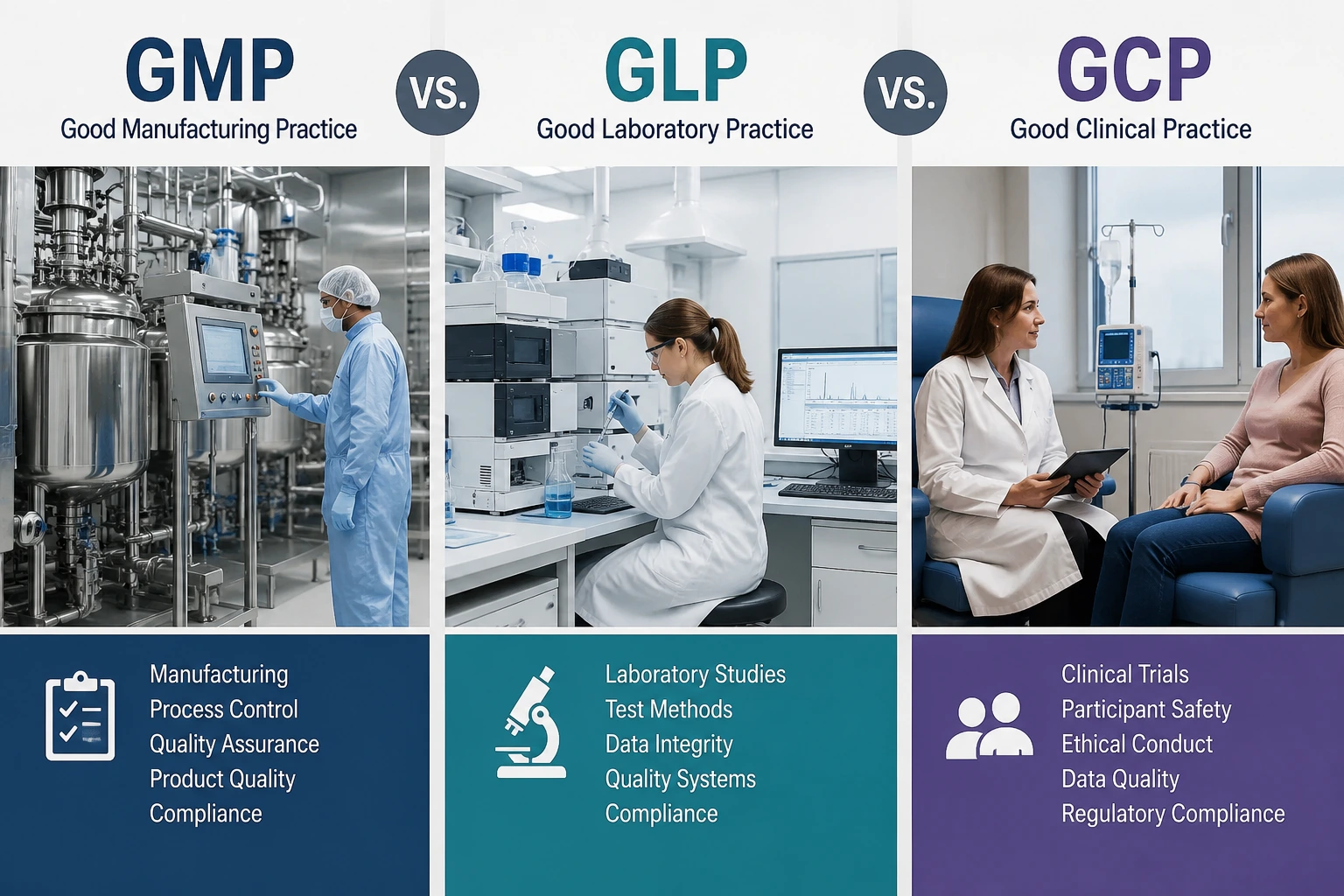
The short answer is that each one governs a different phase of the product lifecycle. GLP ensures the integrity of data from preclinical laboratory studies. GCP protects the rights and safety of human participants in clinical trials. And GMP guarantees that manufactured products are consistently safe and effective.
Think of them as three quality gatekeepers that work in sequence, each building on the one before it. A weakness in any of these pillars can derail an entire drug development program. GLP failures can prevent an Investigational New Drug (IND) application from moving forward. GCP failures can lead to rejected clinical data. And GMP failures can result in product unavailability or even patient harm.
This guide will walk you through each of these three critical standards, compare them side by side, and help you understand exactly when and where each one applies.
What Is GLP? Good Laboratory Practice
GLP, or Good Laboratory Practice, is the quality standard that governs non-clinical laboratory studies. These are the safety studies conducted on animals and in laboratory settings before a product is ever tested in humans.
What Does GLP Cover?
GLP applies to a wide range of safety studies, including safety pharmacology, single-dose and repeat-dose toxicity studies, reproductive and developmental toxicity, genetic toxicology, and carcinogenicity studies. In the United States, GLP regulations are found in FDA 21 CFR Part 58.
The Core Purpose of GLP
The primary goal of GLP is to ensure that the data generated during preclinical research is reliable, reproducible, and trustworthy. GLP does not judge whether the results are positive or negative. Instead, it answers a more fundamental question: Can regulatory agencies trust this data enough to allow human trials to proceed?
GLP focuses on the organizational processes and conditions under which studies are planned, performed, monitored, and recorded. It covers everything from study protocols and standard operating procedures to quality assurance units that oversee compliance.
When Does GLP Apply?
GLP applies from the initiation of preclinical testing all the way through to the submission of an IND application or Clinical Trial Application. If you are running studies that will be submitted to regulators to support a marketing application, GLP compliance is mandatory.
GLP Trainings Archives – GxP Trainings
OECD GLP Training I GLP Training I GxP Trainings
GLP Internal Certified Auditor (FDA Focused) I GLP Training
GLP Internal Auditor Certification (OECD Focused) I GLP Trainings
GLP Training I GLP I FDA I 21 CFR Part 58 Training I
What Is GCP? Good Clinical Practice
GCP, or Good Clinical Practice, is the international ethical and scientific quality standard for designing, conducting, recording, and reporting clinical trials that involve human participants. The most widely recognized framework is the ICH E6(R3) guideline, which was recently updated to incorporate flexible, risk-based approaches and embrace innovations in trial design and technology.
What Does GCP Cover?
GCP covers the entire clinical trial lifecycle, including protocol design, trial conduct, monitoring, auditing, data analysis, and reporting. It addresses critical aspects such as obtaining informed consent from participants, ensuring data integrity, and maintaining participant confidentiality.
The Core Purpose of GCP
GCP has two equally important objectives. First, it protects the rights, safety, and well-being of trial participants. Second, it ensures that clinical data is credible, accurate, and reliable. In essence, GCP balances scientific exploration with ethical safeguards.
Key elements of GCP include informed consent, adverse event reporting, well-documented trial protocols, qualified investigators, and regular monitoring and auditing of clinical studies. The updated ICH E6(R3) guideline now encourages a risk-based and proportionate approach, promoting fit-for-purpose solutions while maintaining the highest standards of participant protection.
When Does GCP Apply?
GCP applies throughout all phases of clinical development, from Phase I through Phase IV trials. Any study that involves testing a product in humans must comply with GCP standards to gain regulatory approval.
GCP Training: ICH E6(R3) Good Clinical Practices | GxP Trainings
Global Pharmacovigilance and Safety Reporting I GVP Trainings
Trial Master File | TMF | GxP Trainings
Certified Regulatory Affairs Professional (CRAP) I RA Certifications
GCP Trainings Archives – GxP Trainings
What Is GMP? Good Manufacturing Practice
GMP, or Good Manufacturing Practice, is the quality standard that governs the production and quality control of pharmaceutical products, medical devices, and other healthcare products.
What Does GMP Cover?
GMP covers every aspect of manufacturing, including raw materials, equipment, facilities, staff training, and quality management systems. Key regulations in the United States include FDA 21 CFR Parts 210 and 211 for pharmaceuticals and Part 820 for medical devices.
The Core Purpose of GMP
The primary goal of GMP is to ensure that products are consistently produced and controlled according to quality standards. GMP minimizes risks in production that cannot be eliminated through final product testing alone. It emphasizes hygienic manufacturing environments, qualified personnel, and robust quality systems to assure the identity, strength, quality, and purity of drug products.
When Does GMP Apply?
GMP applies from the manufacturing of clinical trial materials through to full-scale commercial production. Once a product moves from the laboratory to manufacturing, GMP becomes the governing standard.
GMP Trainings Archives – GxP Trainings
GMP vs GLP vs GCP: Key Differences at a Glance
To make the distinctions clearer, here is a side-by-side comparison of the three standards.
| Aspect | GLP | GCP | GMP |
|---|---|---|---|
| Full Form | Good Laboratory Practice | Good Clinical Practice | Good Manufacturing Practice |
| Phase of Lifecycle | Preclinical (non-clinical) | Clinical development | Manufacturing and commercial production |
| Primary Focus | Reliability and integrity of laboratory data | Protection of human subjects; credibility of clinical data | Consistent quality and safety of manufactured products |
| What It Governs | Non-clinical safety studies on animals and in laboratories | Clinical trials involving human participants | Manufacturing processes, facilities, equipment, and quality systems |
| Key U.S. Regulation | 21 CFR Part 58 | ICH E6(R3) | 21 CFR Parts 210, 211, and 820 |
| Primary Stakeholder | Laboratory and study directors | Sponsors, investigators, and clinical research organizations | Manufacturers and quality assurance teams |
| Consequence of Failure | No IND submission | Rejected or unreliable clinical data | Product recalls, shortages, or patient harm |
How GLP, GCP, and GMP Work Together
While each standard governs a distinct phase, they are not isolated silos. They form a seamless quality journey from the laboratory bench to the patient.
The sequence typically looks like this:
GLP → GCP → GMP
First, GLP ensures that preclinical data is reliable enough to justify moving into human trials. Next, GCP protects participants and ensures clinical data is credible. Finally, GMP guarantees that once a product is approved, every batch manufactured is safe and consistent.
A weakness in any stage can have cascading effects. If GLP data is unreliable, regulators may reject an IND application. If GCP standards are not followed, clinical data may be deemed invalid. And if GMP processes are not controlled, patients could receive unsafe or ineffective products.
Common Misconceptions
Misconception 1: GLP, GCP, and GMP are interchangeable.
They are not. Each applies to a specific phase of the product lifecycle and has distinct requirements.
Misconception 2: GLP is only about laboratory techniques.
GLP is not about the science itself but about the organizational processes, documentation, and quality assurance that make the data reliable.
Misconception 3: GCP only applies to large pharmaceutical companies.
GCP applies to anyone conducting clinical trials, including academic researchers, contract research organizations, and small biotech firms.
Misconception 4: GMP is only about manufacturing.
GMP also covers quality management, documentation, training, and facility design.
Why Understanding These Differences Matters
Whether you are a researcher, a quality professional, a regulatory affairs specialist, or someone just starting your career in life sciences, understanding the differences between GMP, GLP, and GCP is essential.
Each standard comes with its own set of requirements, documentation practices, and regulatory expectations. Working in the wrong framework can lead to compliance failures, wasted resources, and even risks to patient safety. Knowing which standard applies to your work is the first step toward building a successful career or a robust compliance program.
How GxP Trainings Can Help You Master GMP, GLP, and GCP
Navigating the nuances of GMP, GLP, and GCP can be challenging, especially when regulations are constantly evolving. That is where GxP Trainings comes in.
We offer comprehensive, expert-led courses covering each of these three critical standards in depth. Our programs are designed for beginners and experienced professionals alike, translating complex regulatory requirements into practical, audit-ready competencies.
Our GMP Courses
- GMP Fundamentals for Pharmaceutical Professionals
- GMP for Active Pharmaceutical Ingredients (ICH Q7)
- GMP for Sterile and Aseptic Processing
- GMP for Medical Devices (21 CFR Part 820)
- FDA 21 CFR Parts 210 & 211 – Comprehensive Guide
- cGMP Fundamentals – Practical Application and Management Oversight
Our GLP Courses
- GLP Fundamentals for Non-Clinical Safety Studies
- GLP for Preclinical Research and Toxicology
- GLP for Study Directors and Quality Assurance Units
- GLP Data Integrity and Documentation
- FDA 21 CFR Part 58 – GLP Compliance
Our GCP Courses
- Good Clinical Practices (ICH E6(R3) Focused)
- GCP for Clinical Trial Investigators and Site Staff
- GCP for Clinical Research Associates (CRAs) and Monitors
- GCP for Clinical Trial Sponsors and Contract Research Organizations
- GCP for Pharmacovigilance and Clinical Safety Professionals
- GCP for Informed Consent and Patient Rights
- GCP for Electronic Data Capture and Source Documentation
Additional Relevant Courses
- Quality Management Systems (QMS) for GxP Environments
- Data Integrity and ALCOA+ Principles
- FDA 21 CFR Part 11 – Electronic Records and Electronic Signatures
- Internal Auditing and Inspection Readiness
- Computer System Validation (CSV) for GxP Systems
- Pharmacovigilance Fundamentals and GVP
Why Choose GxP Trainings?
Our training programs are continuously aligned with standards from the FDA, EMA, Health Canada, WHO, ICH, and other international regulatory bodies. With over 50 expert courses across multiple GxP domains, we have trained more than 10,000 professionals globally.
Key highlights:
- Expert-led, practical training designed for real-world application
- Self-paced, online learning with immediate access
- Globally recognised certificates upon completion
- Regular updates to reflect the latest regulatory changes, including ICH E6(R3)
Ready to build your expertise in GMP, GLP, and GCP? We invite you to visit our website to explore our full course catalog, register for an account, and start learning at your own pace today.
Conclusion
GMP, GLP, and GCP are the three pillars of quality in the life sciences industry. GLP ensures that preclinical data is reliable. GCP protects human participants and ensures clinical data is credible. And GMP guarantees that manufactured products are consistently safe and effective.
While each standard governs a different phase of the product lifecycle, they work together as a unified framework for patient safety and product quality. Understanding the differences between them is not just academic; it is essential for anyone working in regulated healthcare.
With the right training and a commitment to continuous learning, mastering these three standards is well within your reach. Take that first step today, and you will be well on your way to making a meaningful contribution to the world of regulated healthcare.
Contact GxP Trainings | Life Sciences Training Support
Author

