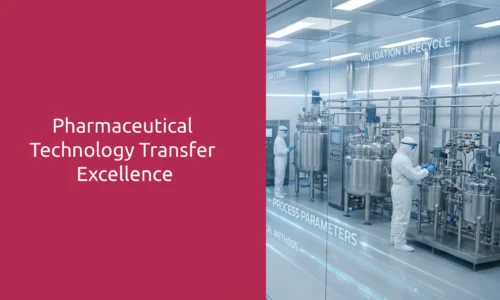
This training program provides a thorough understanding of the principles, processes, and good practices for effective technology transfer in the pharmaceutical industry. The course covers the complete technology transfer lifecycle from initial planning through project close-out.
Technology transfer is defined as activities that transfer product and process knowledge between development and manufacturing, and within or between manufacturing sites to achieve product realisation. This knowledge forms the basis for the manufacturing process, control strategy, process validation approach, and ongoing continual improvement. Successful transfers depend on robust project management processes combined with appropriate product and process understanding.
Participants will learn how to transfer analytical methods, drug-substance processes for both large molecules and small synthetic molecules, and drug-product manufacturing processes. The course addresses transfers between any two parties, whether internal to the same company or external to a contract manufacturing organization.
The program emphasizes science- and risk-based approaches derived from Quality by Design principles, including Quality Target Product Profile, Critical Quality Attributes, Critical Process Parameters, material attributes, design space, and control strategy. Knowledge management is a critical component that encompasses both explicit and tacit knowledge derived from experience.
Quality risk management principles are covered, including risk identification, risk analysis, risk evaluation, risk control, and risk review. Participants will learn to use tools such as Failure Mode and Effect Analysis and Ishikawa diagrams.
The course also addresses communication, partnership, cooperation, and coordination between sending and receiving units. Cultural differences between units must be recognized early with steps taken to ensure appropriate understanding and alignment.
A comparison of key regulatory guidance documents is provided to help participants understand the similarities and differences in global expectations for technology transfer and process validation.
Upon completion of this course, participants will be able to:
The scope of this training program includes technology transfers for analytical methods, drug substance for both large and small molecules, and drug product for various dosage forms. It addresses transfers that may take place at any point during the product lifecycle, including:
The sending and receiving units may be internal to the same company, external between companies, or external to a third party. The transfer is normally from a sending unit that possesses the process knowledge, history, and operational experience to a receiving unit that needs to acquire it.
Not all activities described in the course will apply to every transfer. Companies may select activities appropriate to the type and scale of technology transfer being performed. Early stage transfers may not require all the formal documentation and validation activities required for a commercial transfer.
This training program is intended for professionals involved in pharmaceutical development, manufacturing, quality, engineering, and project management. Specific roles include:
The course is designed using principles from key regulatory and industry guidance documents. These documents provide the framework for quality systems, pharmaceutical development, risk management, process validation, and technology transfer expectations.
Quality system guidance describes a model for an effective pharmaceutical quality system that covers the entire product lifecycle including pharmaceutical development, technology transfer, commercial manufacturing, and product discontinuation. It emphasizes knowledge management as a systematic approach to acquiring, analyzing, storing, and disseminating information. It establishes four elements of the quality system: process performance and product quality monitoring system, corrective action and preventive action system, change management system, and management review.
Pharmaceutical development guidance introduces Quality by Design principles and defines Quality Target Product Profile, Critical Quality Attributes, Critical Process Parameters, material attributes, design space, and control strategy. It states that demonstrating a greater understanding of pharmaceutical and manufacturing sciences can provide a basis for flexible regulatory approaches.
Quality risk management guidance provides principles and tools for managing risk throughout the product lifecycle. It defines the risk management process, including risk identification, risk analysis, risk evaluation, risk control, risk communication, and risk review. It introduces risk management tools including Failure Mode and Effect Analysis, Hazard and Operability Analysis, Fault Tree Analysis, and Ishikawa diagrams.
Drug substance development guidance provides approaches to developing and manufacturing drug substances for both chemical entities and biotechnological and biological entities. It introduces the concept of starting materials, their justification, and the control strategy for drug substance manufacturing.
Process validation guidance outlines three stages: Process Design, Process Qualification, and Continued Process Verification. It links Process Design to technology transfer requirements to understand what must be transferred, including Critical Quality Attributes, Critical Process Parameters, material attributes, and control strategy. It links Process Qualification to confirmation that the receiving unit can deliver the Critical Quality Attributes. It links Continued Process Verification to ensuring that the receiving unit implements monitoring to confirm successful technology transfer.
European guidance on process validation distinguishes between traditional process validation, continuous process verification, and hybrid approaches. It requires justification for the number of validation batches. Specific guidance for biotechnology-derived products addresses virus clearance validation, cell culture consistency, and other biologics-specific considerations.
Qualification and validation requirements provide binding requirements for design qualification, installation qualification, operational qualification, and performance qualification. They require a validation master plan and address cleaning validation and process validation.
Technology transfer guidelines provide organizational and management aspects including model technology transfer agreements and quality agreements. They address transfers to developing countries and specific challenges associated with such transfers, as well as transfer from research and development to manufacturing and between manufacturing sites.
Learners who successfully complete the program will receive a dated, traceable certificate that provides verifiable proof of their achievement for professional records.

We provide training programs designed to help you meet quality and compliance standards. Our courses cover GMP, GLP, GCP, GEP, GDP, and Quality Assurance.