Why cGMP Refresher Training Is Non-Negotiable for Pharmaceutical Professionals
If you work in pharmaceutical manufacturing, you already know that Current Good Manufacturing Practice (cGMP) is the backbone of drug quality and patient safety. But here is a question worth asking: When was the last time you refreshed your cGMP knowledge?
Regulations evolve. Inspection findings shift. New risks emerge. And the FDA expects every person involved in drug manufacturing to stay current.
Under 21 CFR 211.25, training must be conducted on a “continuing basis and with sufficient frequency” to ensure employees remain familiar with cGMP requirements applicable to them. This is not a suggestion—it is a legal requirement.
This blog post explores why cGMP refresher training matters, what the FDA expects, and how GxP Trainings can help you stay compliant.
What Is cGMP Refresher Training?
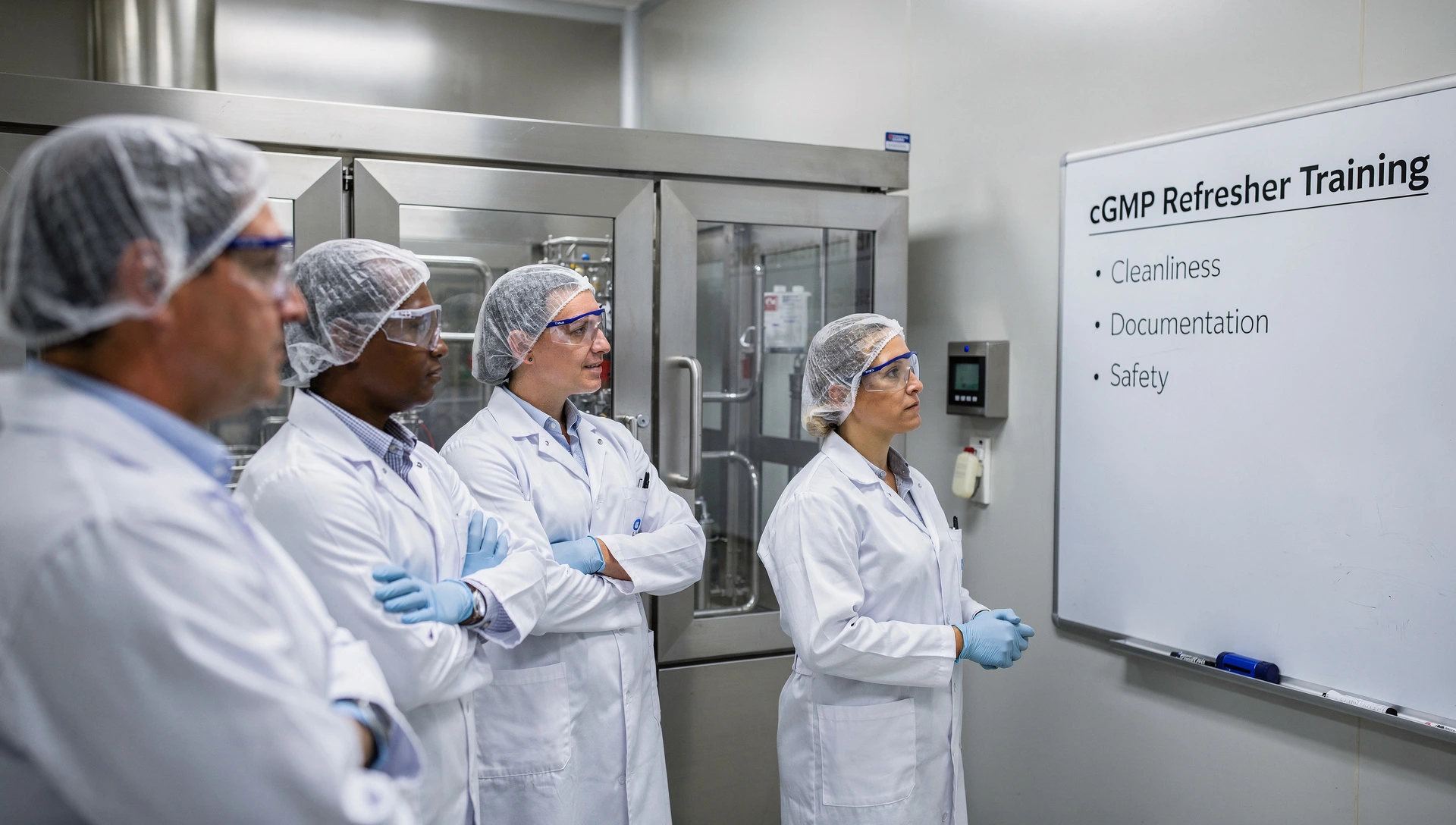
cGMP refresher training is a structured program designed to reinforce foundational GMP knowledge while introducing critical updates, high-risk areas, and common inspection findings. Unlike initial training, which covers basic concepts, refresher training focuses on:
- Regulatory updates – Changes to FDA guidance and enforcement priorities
- Data integrity principles – Practical implementation of ALCOA+ standards
- Lessons from warning letters – Real-world examples of non-compliance
- Risk-based decision-making – Applying cGMP principles to daily operations
The goal is not to re-teach what you already know. It is to sharpen your understanding, close knowledge gaps, and prepare you for the realities of pharmaceutical manufacturing today.
The Legal Basis: What the FDA Requires
The FDA’s expectations for training are clearly defined in 21 CFR 211.25.
| Requirement | Description |
|---|---|
| Education, Training, and Experience | Each person engaged in manufacturing, processing, packing, or holding a drug product shall have the education, training, and experience to perform their assigned functions |
| Specificity | Training must be in the particular operations the employee performs and in cGMP as they relate to the employee’s functions |
| Frequency | Training must be conducted on a continuing basis and with sufficient frequency to assure employees remain familiar with cGMP requirements |
| Documentation | Training records must be maintained to demonstrate compliance |
The FDA expects annual refresher training as the industry standard. When the FDA inspects a facility, they review training records to verify that personnel have received ongoing, job-relevant instruction.
Why Annual Refresher Training Is Critical
1. Regulations Change
cGMP is not static. The FDA regularly updates guidance documents, revises inspectional approaches, and issues new rules. What was acceptable five years ago may not be acceptable today. Without regular refresher training, your knowledge becomes outdated.
2. Warning Letters Highlight Recurring Gaps
Recent FDA warning letters show recurring deficiencies in training. Common findings include:
- Lack of documented training for critical operations
- Failure to provide refresher training after procedure changes
- Insufficient training on data integrity requirements
- Training that is too generic and not role-specific
These findings can lead to warning letters, consent decrees, product seizures, and even criminal prosecution.
3. New Risks Emerge
Data integrity risks, cybersecurity threats, and new manufacturing technologies require updated knowledge. A refresher course ensures your team understands current risks and how to mitigate them.
4. Patient Safety Depends on It
At its core, cGMP exists to protect patients. When manufacturing personnel lack current knowledge, the risk of errors, contamination, and adulteration increases. Annual refresher training is a direct investment in patient safety.
What a High-Quality cGMP Refresher Course Should Cover
A comprehensive refresher course should address the full scope of 21 CFR Part 210 and Part 211 requirements. Key modules typically include:
| Module | Focus Area |
|---|---|
| Foundations of cGMP | History, purpose, regulatory framework, and core principles |
| Organization and Personnel | Quality Control Unit responsibilities, training requirements, hygiene |
| Buildings and Facilities | Design, construction, aseptic processing, penicillin separation |
| Equipment | Design, cleaning, maintenance, calibration, computerized systems |
| Components and Containers | Receipt, sampling, testing, approval, retesting |
| Production and Process Controls | Charge-in, yield calculation, in-process controls, reprocessing |
| Packaging and Labeling | Label control, reconciliation, tamper-evident packaging, expiration dating |
| Laboratory Controls | Testing, stability, reserve samples, method validation |
| Returned and Salvaged Products | Handling, evaluation, destruction, salvaging requirements |
The best refresher courses also incorporate case studies from FDA warning letters and scenario-based learning to help participants apply principles to real-world situations.
Who Needs cGMP Refresher Training?
Under FDA regulations, all personnel whose activities could affect drug quality must receive cGMP training. This includes:
If you work in an FDA-regulated environment and have not completed cGMP refresher training within the last year, now is the time.
The Consequences of Inadequate Training
Failing to provide adequate cGMP training can result in:
| Consequence | Impact |
|---|---|
| FDA Warning Letters | Public documentation of significant violations |
| Product Seizure | Removal of products from the marketplace |
| Injunction | Court order to stop manufacturing until compliance is achieved |
| Prosecution | Fines and imprisonment for responsible individuals |
| Import Alerts | Products detained at the border |
| Consent Decree | Court-enforced agreement with independent oversight |
| Reputational Damage | Loss of customer trust and business opportunities |
These consequences are not theoretical. The FDA actively enforces training requirements, and recent inspections have resulted in significant actions against companies with inadequate training programs.
How GxP Trainings Can Help
At GxP Trainings, we offer a comprehensive FDA cGMP Refresher Course designed to meet the FDA’s “continuing and frequent” training mandate.
Course Highlights:
- 10 comprehensive modules covering all aspects of 21 CFR Part 210 and Part 211
- Self-paced online learning – complete on your schedule
- Real-world case studies based on actual FDA warning letters
- Module assessments with a minimum 80% passing score requirement
- Final examination to validate comprehensive understanding
- Certificate of Completion with unique verification number
- Lifetime access to course materials
- $149 investment in your professional development and compliance
Whether you are a production operator, QA specialist, warehouse manager, or department head, this course provides the current, practical knowledge you need to maintain compliance and protect patient safety.
Take Action Today
cGMP refresher training is not optional. It is a regulatory requirement, a patient safety imperative, and a professional responsibility.
Do not wait for an FDA inspection to discover training gaps.
Enroll Now in Our FDA cGMP Refresher Course
Invest in your knowledge. Protect your patients. Stay compliant.
Author