The pharmaceutical industry witnessed a seismic shift in 2022 with the release of the revised EU GMP Annex 1: Manufacture of Sterile Medicinal Products. If you are involved in Quality Assurance, Microbiology, Engineering, or Production, you know this isn’t just a regulatory update—it is a complete rethinking of how we ensure patient safety.
Gone are the days of relying solely on end-product testing. Today, the focus is holistic: Prevention over detection.
At GXP Trainings, we have broken down the complex 50+ page document into an actionable learning path. Whether you are new to sterile manufacturing or a seasoned professional, our dedicated EU GMP Annex 1 Training Program is designed to bridge the gap between theory and real-world application.
Let’s explore the high-impact pillars of this critical regulation.
The Heart of the Annex: The Contamination Control Strategy (CCS)
The single most important concept introduced (or rather, cemented) in the 2022 revision is the Contamination Control Strategy (CCS) .
The Annex explicitly states that “Sole reliance on any terminal process or finished product test for sterility is not acceptable.” Instead, manufacturers must implement a CCS across the entire facility.
What is a CCS?
It is a documented, living plan that defines all critical control points. It assesses the effectiveness of design, procedural, technical, and organizational controls.
- It includes: Vendor approval, cleaning/disinfection, process validation, trending, and CAPAs.
- It excludes: Financial targets or marketing strategies.
- The Goal: To drive continuous improvement, not just compliance.
Training Insight: Our EU GMP Annex 1 course includes a step-by-step module on how to build and maintain a CCS, including interactive case studies on root cause analysis.
Cleanroom Grades & Barrier Technologies (RABS vs. Isolators)
Understanding the four grades (A, B, C, D) is fundamental, but the Annex places heavy emphasis on how you protect these zones.
Critical Environmental Grades
- Grade A: The critical zone (e.g., filling zone, stopper bowls). Requires unidirectional airflow (First Air) . Direct human intervention must be minimized.
- Grade B: The background for Grade A (when not using an isolator). Strict gowning and pressure monitoring required.
- Grades C & D: Support zones for less critical steps or background for isolators.
Barrier Technologies
The regulation strongly favors physical separation to eliminate human contamination risk.
- Isolators: Closed or open. They require automated, validated bio-decontamination (sporicidal agent). Glove integrity testing is mandatory at the start and end of each batch.
- RABS (Restricted Access Barrier Systems): Provide Grade A protection but sit in a Grade B background. Unlike isolators, they are not fully sealed from the room environment.
Did you know? Sinks and drains are strictly prohibited in Grade A and B areas. Even your utility pipes in cleanrooms must be installed without recesses to allow proper cleaning.
Personnel: The Biggest Variable in Aseptic Processing
Annex 1 is brutally honest: humans shed particles. Therefore, the rules for personnel have tightened significantly.
Gowning & Qualification
- Grade B Gowning: Requires sterilized garments, double gloves (sleeves tucked into the second pair), full facial coverage (hood, mask, eye coverings).
- Qualification: Personnel must pass a gowning qualification (visual AND microbial assessment of gloves, chest, and mask) at least annually.
- Disqualification: There must be a system to disqualify personnel based on adverse trends or failure in an Aseptic Process Simulation (APS).
Aseptic Behaviour
- Movement must be slow and methodical.
- Operators are trained to never block unidirectional airflow.
- Personal items (mobile phones, jewelry, makeup) are completely banned unless manufacturer-supplied for cleanroom use.
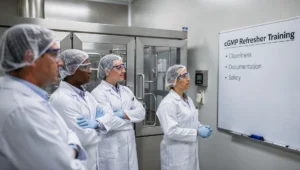
Train with us: Our training program includes video modules on proper gowning sequences and aseptic behavior simulations to prepare your team for internal audits.
Production: Terminal Sterilization vs. Aseptic Processing
The hierarchy of sterility assurance is clear: Terminal sterilization is preferred. If a product cannot be terminally sterilized, only then should aseptic processing be justified.
Key Production Requirements
- Terminal Sterilization: If a product has “unusual risk” (slow filling, wide necks), it must be filled in Grade A with a Grade C background.
- Aseptic Processing: Requires a defined list of “qualified interventions.” Any non-qualified intervention requires Quality Unit authorization.
- Lyophilization (Freeze-Drying): If you manually load a lyophilizer with no barrier, it must be sterilized before every load.
- Blow-Fill-Seal (BFS): For aseptic BFS, the extrusion and filling zones must meet Grade A conditions. Particle monitoring for BFS is relaxed due to polymer heat, but viable monitoring remains critical.
Container Closure Integrity
For fusion-sealed containers (ampoules, BFS), visual inspection is NOT acceptable as an integrity test. You must use validated 100% integrity testing (e.g., vacuum decay, high voltage leak detection).
Environmental Monitoring & APS: Proving Control
Monitoring is not just about collecting data; it is about immediate risk detection.
- Continuous Monitoring: Grade A requires continuous total particle monitoring to capture transient events and interventions.
- Action Limits: If a Grade A plate shows any growth (CFU > 0), a full investigation is mandatory. Organisms found in Grade A/B must be identified to the species level.
- Aseptic Process Simulation (Media Fill):
- Frequency: Twice a year (every six months) for each shift and line.
- Target: Zero growth. Any contamination is a failed simulation.
- Remediation: A failed APS requires a minimum of three consecutive successful re-runs before the line is qualified again.
Why Take the Official GxP Trainings Course?
Reading the raw text of Annex 1 can be overwhelming. There are nuances regarding “PUPSIT” (Pre-use Post-sterilization Integrity Testing), “First Air” definitions, and “Closed System” boundaries that are often misunderstood.
Our EU GMP Annex 1 Training Program is specifically designed to address the 2022 revision by offering:
- Module-Based Learning: Covering all 6 areas (CCS, Premises, Equipment, Production, Monitoring, QC).
- Practical Scenarios: Real-world case studies on how to handle environmental excursions and failed media fills.
- Assessment Tools: 60+ multiple-choice questions (like the ones provided in the source document) to test your knowledge.
- Certification: Prove your competence to regulators and employers with a verifiable certificate.
Who Should Attend?
- Pharmaceutical Manufacturers
- QA/QC Personnel
- Microbiologists and Engineers
- Production Operators
- Regulatory Affairs Staff
Do not let a simple misinterpretation of Grade B airflow or isolator glove testing lead to a regulatory 483.
👉 Secure your spot in the EU GMP Annex 1 course today! 👈
FAQ (Schema Markup Ready)
Q: Does EU GMP Annex 1 apply to non-sterile products?
A: Yes, partially. Principles like CCS, cleanroom design, and gowning may be applied to non-sterile products (e.g., creams, liquids) if contamination control is critical. However, the manufacturer must document which principles were used.
Q: What is “First Air” in Grade A?
A: “First air” refers to filtered air that has not been interrupted (by an operator’s hand or equipment) before contacting the exposed sterile product or container surface. You must not block first air.
Q: How often must operators be re-gowned qualified?
A: At least annually. This includes both visual inspection and microbial sampling of the gown (gloves, chest, forearms, hood).
Q: Can I use a single media fill to cover multiple shifts?
A: No. The Aseptic Process Simulation must capture the shift changeover. You must simulate the worst-case conditions, including different operators, for each shift.
Author