
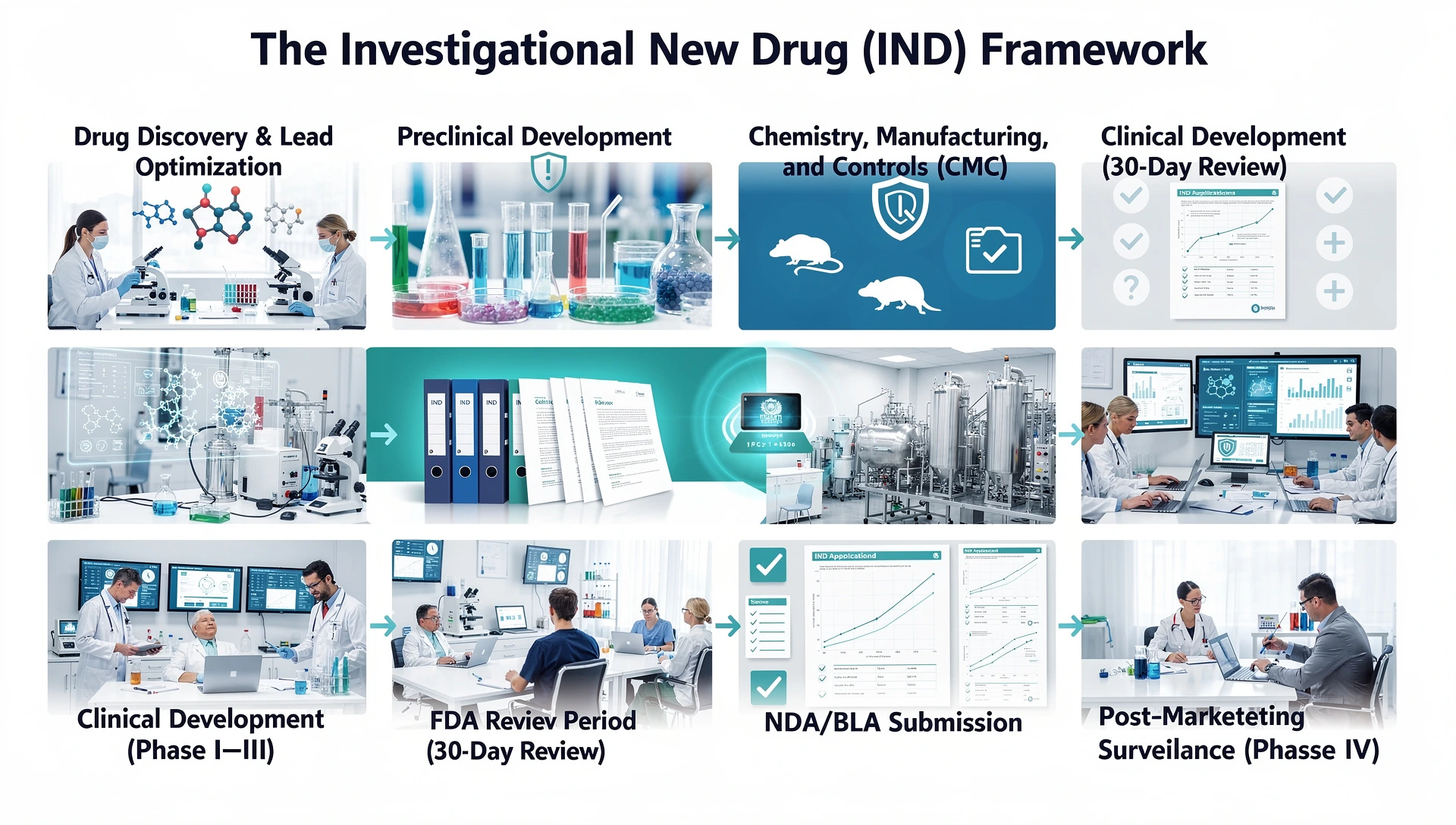
If you work in clinical research, you have heard the term “IND.” But understanding the difference between an IND as a permission slip versus an IND as a legal exemption is critical to compliance.
Before a promising new drug can ever reach a patient, it must navigate the complex waters of the Investigational New Drug (IND) framework. Managed by the U.S. Food and Drug Administration (FDA), the IND is not just an application; it is the entire regulatory ecosystem governing the drug from “lab to human.”
At GxP Trainings, we have broken down this complex lifecycle into a comprehensive certification program. Whether you are a Clinical Research Associate (CRA), Regulatory Affairs Specialist, or a Principal Investigator, understanding the IND is non-negotiable for career growth and patient safety.
Let’s break down the high-level anatomy of the IND and how our course, “The Investigational New Drug (IND) Framework”, prepares you for every regulatory hurdle.
What is the Investigational New Drug (IND)? (The “Why”)
Most professionals mistakenly believe the IND is just an application for FDA permission. In reality, under the Federal Food, Drug, and Cosmetic Act (FD&C Act) , shipping an unapproved drug across state lines is technically illegal.
The IND provides the exemption.
It allows a Sponsor to ship an investigational drug to qualified clinical investigators for research. However, to obtain this exemption, the Sponsor must prove it is “reasonably safe” to proceed. This is done through a comprehensive data package that includes animal pharmacology/toxicology studies and Chemistry, Manufacturing, and Controls (CMC) information.
The 30-Day Clock: How an IND Goes into Effect
One of the highest-stakes timelines in the industry is the 30-day review period.
When the FDA receives an IND, they stamp the receipt date. The Agency then has 30 calendar days to review the submission. If the FDA identifies significant risks to human subjects, it will issue a Clinical Hold. If not, the IND goes into effect automatically on day 30, and the clinical investigation may begin.
The Three Phases of Clinical Investigation
Our training dives deep into 21 CFR 312.21, which outlines the three distinct phases. While they often overlap, their objectives are strictly defined:
- Phase 1 (20-80 subjects): Focuses on safety, metabolism, and dose-ranging. Usually conducted in healthy volunteers.
- Phase 2 (Several hundred subjects): Focuses on effectiveness and short-term risks. This is where controlled studies (placebo vs. drug) begin.
- Phase 3 (Several hundred to thousands): Confirms the overall benefit-risk relationship to support a New Drug Application (NDA).
Why Formal IND Training is Essential
Navigating the IND requires mastery of multiple CFR Parts (21 CFR Parts 11, 50, 54, 56, 210/211, and 312). A single mistake in Safety Reporting (312.32) or Informed Consent (Part 50) can result in a Clinical Hold or Investigator Disqualification.
This is why GxP Trainings developed the IND Framework Course.
What is the Investigational New Drug (IND)? (The “Why”)
Most professionals mistakenly believe the IND is just an application for FDA permission. In reality, under the Federal Food, Drug, and Cosmetic Act (FD&C Act) , shipping an unapproved drug across state lines is technically illegal.
The IND provides the exemption.
It allows a Sponsor to ship an investigational drug to qualified clinical investigators for research. However, to obtain this exemption, the Sponsor must prove it is “reasonably safe” to proceed. This is done through a comprehensive data package that includes animal pharmacology/toxicology studies and Chemistry, Manufacturing, and Controls (CMC) information.
CMC Training I CMC for Pharma and Biologics I GxP Trainings
The 30-Day Clock: How an IND Goes into Effect
One of the highest-stakes timelines in the industry is the 30-day review period.
When the FDA receives an IND, they stamp the receipt date. The Agency then has 30 calendar days to review the submission. If the FDA identifies significant risks to human subjects, it will issue a Clinical Hold. If not, the IND goes into effect automatically on day 30, and the clinical investigation may begin.
The Three Phases of Clinical Investigation
Our training dives deep into 21 CFR 312.21, which outlines the three distinct phases. While they often overlap, their objectives are strictly defined:
- Phase 1 (20-80 subjects): Focuses on safety, metabolism, and dose-ranging. Usually conducted in healthy volunteers.
- Phase 2 (Several hundred subjects): Focuses on effectiveness and short-term risks. This is where controlled studies (placebo vs. drug) begin.
- Phase 3 (Several hundred to thousands): Confirms the overall benefit-risk relationship to support a New Drug Application (NDA).
Why Formal IND Training is Essential
Navigating the IND requires mastery of multiple CFR Parts (21 CFR Parts 11, 50, 54, 56, 210/211, and 312). A single mistake in Safety Reporting (312.32) or Informed Consent (Part 50) can result in a Clinical Hold or Investigator Disqualification.
Ready to Master the IND Lifecycle?
Don’t let regulatory complexity put your clinical trial at risk. The “Investigational New Drug (IND) Framework”** course provides an end-to-end breakdown of the IND process.
What you will learn:
- The Legal Basis: The IND Exemption vs. The Prohibition (21 CFR 312.2).
- The Application: A detailed walkthrough of Form FDA 1571, the Investigator’s Brochure, and CMC sections.
- Safety First: Master IND Safety Reports (15-day vs. 7-day timelines under 312.32).
- Phase 1 CGMP: Specific recommendations for manufacturing investigational drugs (FDA July 2008 Guidance).
- Expanded Access: How to handle Treatment INDs and emergency use.
Course Features:
- 13 In-Depth Modules
- Module Quizzes (80% passing score)
- Certificate of Completion
👉 Target Audience: CRAs, CRCs, Regulatory Affairs, Principal Investigators, CRO Personnel, and Quality Assurance professionals.
Enroll in the IND Framework Course Today (https://www.gxptrainings.com/courses/the-investigational-new-drug-ind-framework/)